Everything Everywhere All at Once
We are besieged by many problems coming together at once, a phenomenon some refer to as a polycrisis. Identity conflicts in the form of culture wars, political correctness, ethnic tensions, and xenophobia are on the rise. Populism and the growing popularity of autocratic leaders in democratic countries are also increasing. Climate change continues to threaten our natural resources at an unexpectedly rapid pace despite the growing use of renewable energy. And, in all of this, the rich keep getting richer, and the poor find it increasingly difficult to escape poverty.
Many people, like me, with wealth to share see ourselves as part of the solution. We want to make a positive difference in the lives of others through our foundations and individual donations. At the same time, the extent of the problems we face can easily lead us to feel overwhelmed. So, we work hard to protect the resources we have and seek reassurance in funding familiar causes and grantees.
Yet at the same time we may wonder if our resources could be better leveraged. How can we have a broader and more sustainable impact? The good news is that by thinking systemically, we can learn
- how all the above symptoms are connected,
- the root causes of the polycrisis, and
- what highly leveraged actions we can take to address all of them.
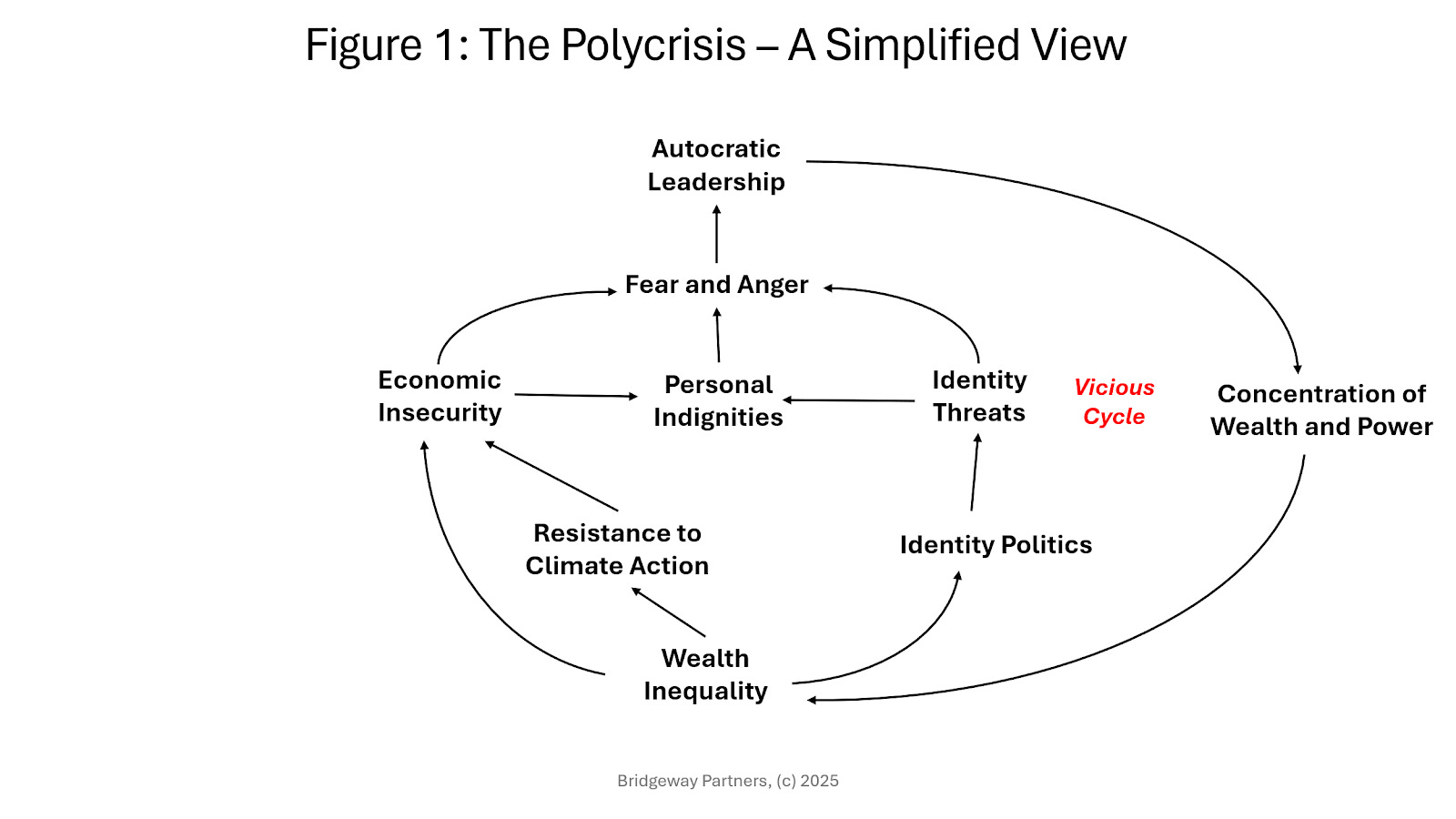
For example, autocratic leadership emerges when people seek a strong leader to rescue them from the economic insecurity, personal indignities, and identity threats they experience. Economic insecurity is, in turn, increased by growing wealth inequality and climate-related disasters. Climate disasters risk becoming even worse when wealthy people whose income depends on the fossil fuel industry resist climate action. Threats to one’s identity increase when wealthy people deliberately pit poor people of different races, genders, and nationalities against one another. All these factors can be traced back to growing wealth inequality—especially in developed nations where people at the top have unduly benefited from globalization at the expense of everyone else. Moreover, wealth inequality is amplified in turn by autocratic leaders who use their authority to further concentrate wealth and power in the hands of a few (see figure 1 below).
You Are the Leverage You Seek
Here’s the good news. For the wealthy people reading this post, you can make the positive difference you want to make. And the bad news. You can be part of the solution only when you first see how you are part of the problem. As wealth holders, we are each part of the system that generates wealth inequality, and that is why we are an essential part of the solution. This is not meant to blame any individual for what is happening, but rather to empower each of us to become more effective in doing something about it. This is because the greatest control any one of us has over a system is through our own intentions, thinking, and actions. You are the leverage you seek!
What You Can Do
So, what does this mean in practice?
- Assess your intentions for giving. Are you motivated to give back because you have derived a lot of your wealth from the existing system? Do you want to mitigate the negative impacts of the current system, otherwise known as extractive capitalism? Or do you want to change the system itself—to create a regenerative economy that increases the likelihood of your children and grandchildren living in a healthier, more sustainable, and more peaceful world?
- Examine your assumptions as a donor. Do you believe that your wealth makes you a more deserving or smarter person? Or do you believe that your grantees understand what they need better than you do, and they should be the ones to decide how to spend the money you give them? Do you believe that giving to individual organizations or programs in the short term is desirable because the results of your donations are easier to measure? Or do you believe that funding the development of coalitions and ecosystems of change over the long term is more likely to shift the interdependent dynamics driving the current system, even if the returns on your own investment might be harder to quantify?
- Consider some of the following actions. Use your money to advocate for change—even if it means giving donations that are not tax-deductible. Promote progressive taxation to distribute wealth more equitably. Protect voter rights to ensure that power remains distributed. Invest in institutions such as media, think tanks, and education that value facts, science, diverse thinking, and discernment. Invest in religious organizations that honour the best of our spiritual traditions and values of compassion as well as justice, and optimism as well as honesty.
Leo Tolstoy observed, “Everyone thinks of changing the world, but no one thinks of changing himself.” By thinking systemically about interdependencies across the many problems we face, we can change the world by focusing on changing ourselves first.
Note: This post was originally published in Substack in the column Who Gives? sponsored by Glen Galaich, CEO of the Stupski Foundation.